


reoviva™ · five minutes a day.Slant Board
Stand on it while the kettle boils. Your calves get the stretch the bottom stair never quite gives them, and your squats go deeper. Five minutes, most days.
How many?
Couldn't load pickup availability
Will this work for me?
If your calves feel tight, your mornings start stiff or your squats stop halfway, this is what it's built for. Runners, walkers and people who sit all day use it the same way: five minutes, most days.
It's a stretching tool, not a treatment. If you have pain that doesn't settle, an injury, or you've had surgery, check with your physio or GP first.
Still not sure? You have 90 days to decide. If it isn't for you, email us and we'll sort it out.
Is 20° too steep to start?
For most people 20°, the lowest setting, is a gentle start.
If it still feels like a lot: keep one foot on the floor and one on the board, hold for 15 seconds instead of 30, and keep a hand on the wall. Swap feet and build up from there. The 4-week routine moves you to 30° in week two, at your own pace.
Why not just use a stair?
If the stair works for you, keep going. On a stair you're on the balls of your feet, usually one leg at a time, holding the rail, at whatever angle your staircase happens to be.
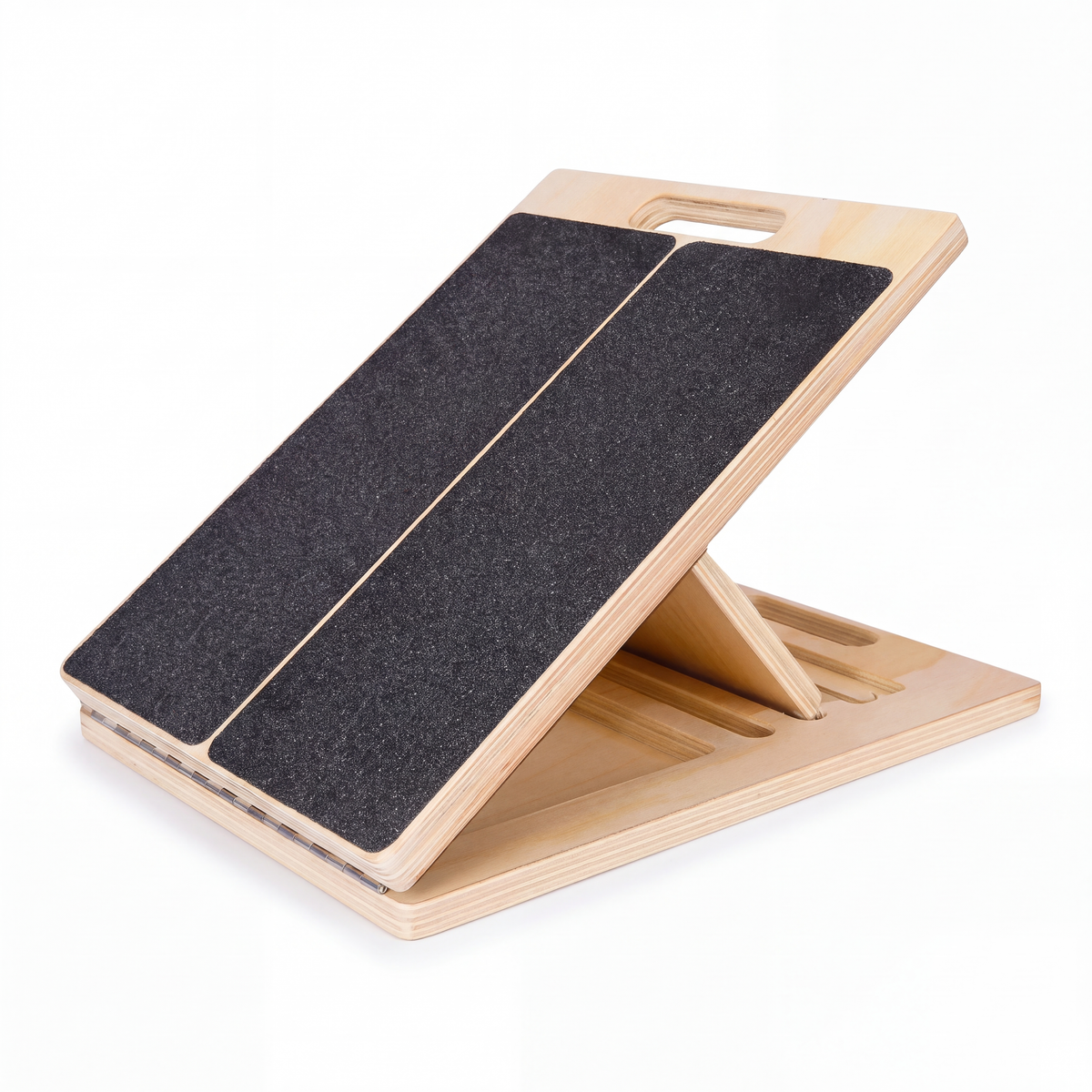
On the board both feet are flat, your hands are free and you choose the angle, from 20° to 45°. Turn it around and it's a ramp for deeper, more upright squats.
Weight limit, angles & size
| Max user weight | 136 kg (21.4 st) |
| Angles | 20°, 30°, 35°, 40°, 45° |
| Platform | 40 × 30 cm (15.7 × 11.8 in) |
| Board weight | 2.1 kg |
| Build | Layered wood, grip top, non-slip base. Folds flat. |
| In the box | The board, folded flat, nothing to assemble. The 4-week routine arrives by email. |
Use on a flat, hard floor. Keep a hand on a wall or worktop the first few times you step on.
Delivery & 90-day guarantee
Ships from our UK warehouse in 1–3 working days. Delivery then takes 2–3 days, free and tracked. We currently deliver to England, Scotland and Wales.
90 days to decide. Use it. If it hasn't earned its place, email hello@reoviva.com with a photo of the board and we'll sort out a full refund.


Stiff mornings start at the ankle.
Tight calves make every step, squat and staircase work harder than it should. Physios stretch them on an incline for a reason: both feet flat, standing tall, at an angle you control. Now that incline lives under your sofa.
Not another gadget. A five-minute habit you'll actually keep.
When do you need it?

Loosen up before the first steps of the day.
Keep it by the bed or next to the kettle. Thirty seconds at the lowest angle with your knees straight, thirty with them soft. By the time the tea has brewed, your calves have had the stretch they've been asking for since you woke up.

The calf routine runners keep meaning to do.
A stretch before you head out, slow calf raises when you're back. On a stair that means one foot, one hand on the rail and whatever angle your staircase happens to be. On the board, both feet are flat and you choose the angle.

Flip it, and squat deeper the first time you try.
Heels up, knees forward, back upright. Raising your heels takes stiff ankles out of the way, so you sink lower without tipping forward, and you feel your thighs doing the work instead of your lower back.

Eight hours in a chair. Five minutes on the board.
Long spells of sitting are exactly when physios suggest stretching your calves. Keep it under the desk and stand on it during calls, or do a round when you get home. It's the easiest habit there is: you just stand.
Both feet flat. The angle you choose.
The stair stretch works for plenty of people. It's also a balancing act: heels hanging off an edge, a hand on the rail, at whatever angle your staircase happens to be.

- Whole foot downHeel on the board, not hanging off an edge. No step digging into the ball of your foot.
- The angle you chooseFive settings, 20° to 45°. Start at the lowest and step up as you loosen.
- Hands freeBoth feet side by side on a 40 × 30 cm grip top. No balancing on one leg, no holding the rail.
How it compares
| Stair edge | Foam wedge | Reoviva | |
|---|---|---|---|
| Both feet flat, full contact | balls of feet | ||
| Angle you can change | fixed | 5 angles | |
| Steep enough for a deep stretch | low | up to 45° | |
| Hands free | hold the rail | ||
| Doubles as a squat ramp |
Looser calves. Deeper squats. Easier mornings.
What five minutes on the incline actually works.

Calves & Achilles
Toes up, heels down, knees straight: your whole calf and Achilles get a long, even stretch. Soften your knees and the stretch moves lower, into the soleus, the deep calf muscle a straight-leg stretch misses.

Calf strength
Week four adds slow calf raises: up in one second, down in three. Lowering slowly down the incline works your calves through their full range.

Thighs & squat depth
Turn the board around and squat. Raised heels take stiff ankles out of the way, so you sink lower with an upright back and your thighs do the work.
In a study of 101 adults, less ankle movement meant shallower squats. Kim et al., Journal of Human Kinetics, 2015
Ankle range & balance
Regular calf stretching adds ankle range: slowly, and only with consistency. That range matters. In adults over 60, ankle flexibility was one of the strongest predictors of balance.
Radford et al., British Journal of Sports Medicine, 2006 · Menz, Morris & Lord, Journal of Gerontology, 2005Incline calf stretching is a staple of physiotherapy. One NHS patient leaflet even notes: “Adjustable, plastic incline boards can be bought online.” Ours is wood.Kingston and Richmond NHS Foundation Trust, “Calf muscle stretches” patient leaflet
These studies looked at calf stretching and ankle movement in general, not at this board specifically. The Reoviva Slant Board is a stretching and exercise tool, not a medical device.
For people who'd rather keep moving than sit it out.
Stiff first thing. Back to running after a break. Squats that stop halfway. If your calves have felt tight for longer than you can remember, this is where five minutes a day goes. Not a medical device and not a cure, just the simplest stretching tool there is.
Ninety days. Then decide.
Stretching works on consistency, not intensity. Use it most days for a month or two. That's long enough to know whether it has earned its spot by the sofa.
If it hasn't, email us and we'll sort out a full refund.
Questions people ask before they buy
Which angle should I start on?
The lowest one, 20°. Knees straight for 30 seconds, then knees soft for 30. Move up an angle when 30 seconds at the current one feels easy. Going steeper too soon doesn't speed anything up.
Is 20° too steep for me?
For most people 20° is a gentle start. If it still feels like a lot, put one foot on the board and keep the other on the floor, hold for 15 seconds instead of 30, and keep a hand on the wall. Swap feet and build up from there.
How long before I notice a difference?
You'll feel the stretch the first time you stand on it. Feeling looser day to day takes consistency: give it two to four weeks of most-days use before you judge it. That's exactly why you have 90 days.
Why not just use the stairs?
If the stair works for you, keep going. The board is for everyone who finds it awkward: you're on the balls of your feet, usually one leg at a time, holding the rail, at whatever angle your staircase happens to be. On the board both feet are flat, your hands are free and you choose the angle. And it doubles as a squat ramp.
Shoes, socks or barefoot?
Barefoot or grippy socks are best. Trainers are fine too. Avoid smooth socks, and use it on a flat, hard floor rather than a rug.
How much weight does it hold?
Up to 136 kg (21.4 stone). The support clicks into a notch and the board sits flat on its base, so it doesn't rock.
Does it need assembling?
No. Unfold it, click the support into the notch you want, step on. Folded flat it slides under a sofa or bed.
Can I use it after an injury or surgery?
Ask your physio or GP first. Plenty of people use an incline board as part of their rehab, but the right angle and timing depend on you, and that's their call, not ours.
Is this a medical device?
No. It's a stretching and exercise board. It isn't intended to diagnose, treat or prevent any condition. If you have pain that doesn't settle, see your GP or a physiotherapist.
How fast is delivery?
It ships from our UK warehouse within 1–3 working days and arrives 2–3 days later. Delivery is free and tracked. We currently deliver to England, Scotland and Wales.
What if it's not for me?
You have 90 days. If it hasn't earned its place, email hello@reoviva.com with your order number and a photo of the board and we'll sort out a full refund.
Five minutes a day.
Unfold it tonight. Use it every morning.
$79.00 for one board, $132.56 for two. Free UK delivery, 90 days to decide.
Questions first? hello@reoviva.com. A real person answers.